
The Asian continent is one of the largest and fastest-growing trading regions with a higher share of the global marketplace. The continent, being home to major economic powers like China, Japan, India, South Korea, and Singapore, has represented itself as one of the backbones of international manufacturing, technology, agriculture, and industrial production. The advanced supply chains, modern ports, and free trade agreements have expanded the consumer markets while solidifying the overall ranking of the continent.
Asia Import Export Data are considered valuable tools because they help business authorities with the latest intelligence on trade activities. The shipment-level customs intelligence helps businesses with the identification of verified buyers, reliable suppliers, analysis of competitors, and monitoring of product demand rates. Organizations utilizing the authentic trade data can properly improve their sourcing strategies with a reduction in their operational risk.
THE SIGNIFICANT ROLE OF ASIA IN GLOBAL TRADE
Asia has played a dominant role in the global economy mainly because of its diversified manufacturing capabilities, technological innovation, and expanding industrial production. The region has been serving as the world’s leading supplier while maintaining its integrity in the machinery, textiles, chemicals, and automobiles trade. China is one of the largest manufacturing economies, with Japan and South Korea leading the automotive, electronics, robotics, and semiconductor technologies. The continuous expansion of India in pharmaceutical, engineering, chemical, and information technology exports has solidified the Southeast Asian countries’ role.
The maintenance of strong trade relationships with North America, Europe, Africa, the Middle East, and Latin America has maintained Asia’s ranking as a significant region of trade. Continuous investment in digital infrastructure, renewable energy, logistics, and artificial intelligence has further strengthened global competitiveness. Asia import-export trade datahighlighted the comprehensive shipment level intelligence for facilitating the evaluation of international trade patterns with active monitoring of competitor activities and identification of sourcing opportunities.
THE COMPREHENSIVE OVERVIEW OF ASIA’S IMPORTS
The import of a broad range of products by Asian authorities has supported industrial production, advanced manufacturing, and consumer markets. Different imported commodities, including industrial machinery, semiconductors, crude oil, and natural gas, have maintained continuous trade in automotive components and precious metals. China, India, Japan, South Korea, Singapore, and Thailand have collectively accounted for a substantial portion of the import demand rate.
The overall hike in investment in electric vehicles, semiconductor manufacturing, renewable energy, and industrial automation has increased Asia’s imports of advanced technologies. Asia import data has allowed businesses to properly analyse supplier performance evaluation of sourcing destinations and monitor shipment frequencies. The verified customs intelligence overall supports informed procurement decisions with the proper improvement of global supply chain efficiency.
THE EXPORT MARKET OVERVIEW OF ASIA
Asia has been playing a leading role in the global marketplace with effective supply of electronics, machinery, semiconductors, automobiles, textiles, and chemicals. China is one of the regional export authorities that has been dominating the trade sector of electrical machinery, consumer electronics, industrial equipment, and manufactured products. Japan is engaged in the effective trade of advanced machinery, robotics, automotive products, and precision equipment, whereas South Korea is engaged in the supply of semiconductors, shipbuilding, automotive, and electronics exports.
The United States, the European Union, Africa, the Middle East, and Latin America and Oceania are the latest export destinations. The continuous innovation of the expanding manufacturing capacity and the strong logistics infrastructure has strengthened Asia’s export competitiveness. Asia import-export data enables exporters to identify verified international buyers and evaluate market demand rates.
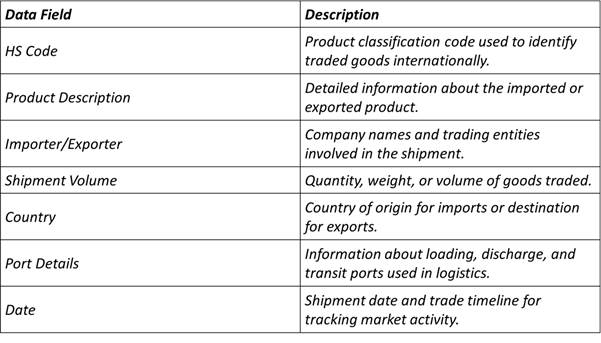
WHAT INFORMATION IS AVAILABLE IN ASIA IMPORT-EXPORT DATA?
WHY ARE IMPORT-EXPORT DATA PROVIDERS IMPORTANT?
Reliable import-export data providers are considered important because they help business authorities with the expansion of trade into international markets. Reliable access to verified shipment-level customs intelligence overall allows organizations to properly identify profitable opportunities and reduce sourcing risk.
Import Globals is considered a trusted platform that provides detailed intelligence on Asia import customs data. Businesses can properly leverage the understanding of exporter information, shipment histories, HS code, intelligence, and international trade statistics. The utilization of accurate customs data helps businesses discover reliable suppliers, with identification of effective buyers and benchmarking of competitors.
HOW DOES ASIA IMPORT-EXPORT DATA PROMOTE BUSINESS GROWTH?
Asia import-export data has been serving as a valuable tool because it helps business authorities with the latest intelligence for manufacturers, exporters, importers, logistics providers, and market researchers. Below are the factors that represent why Asia import-export data promotes business growth.
- Verified buyer identification – The acknowledgement of the verified buyers of a specific category helps businesses identify the active importers, wholesalers, and distributors across Asian and international markets.
- Supplier discovery – The companies can properly locate the reliable manufacturers with effective acknowledgement of exporters and sourcing partners while reducing the procurement risk.
- Competitor shipment analysis – The shipment-level intelligence on the latest trade activities helps the businesses with analysis of competitor exports and supplier relationships.
- Market opportunity analysis – The historical customs records help businesses with emerging opportunities for expansion with acknowledgement of high-demand products and seasonal trends.
- Supply chain optimization – Organizations trying to be progressive can even improve procurement planning with a reduction in logistics costs while strengthening the supplier relationships.
WHY IS ASIA IMPORT-EXPORT DATA IMPORTANT FOR GLOBAL TRADE ANALYSIS?
Asia import-export data is considered important for global trade analysis because it helps businesses understand shipment-level customs intelligence. Essential datasets, including Asia import-export data and Kenya Import Data, facilitate the trade expansion of the latest authorities with comprehensive visibility into the regional trade flows.
Businesses can properly evaluate the import volumes, export destinations, pricing movements, and industry growth to support strategic planning and investment decisions. The reliable availability of trade intelligence enables the organization to anticipate market changes with improved forecasting accuracy.
THE FUTURE TRADE OUTLOOK OF ASIA IMPORT-EXPORT DATA
Asia import-export data is considered to be beneficial for business growth. The continuous investment in advanced manufacturing, semiconductor production, and renewable energy has supported artificial intelligence and smart logistics. The government initiatives promoting industrial modernization, free trade agreements, and digital customs and transformation have strengthened the region’s position in global commerce.
The adoption of AI-powered analytics, block chain-enabled logistics, and real-time shipment monitoring has improved trade transparency while supporting operational efficiency. Businesses utilizing Asia import-export data can gain valuable insights into the latest activities of emerging markets.
CONCLUSION
Asia has been an important trading continent with world-class manufacturing capabilities, technological innovation, and a diversified industrial base. The leadership of the continent in electronics, machinery, automotive production, and pharmaceuticals is due to the advancement of manufacturing units.
Businesses looking for long-term global success can properly understand Asia import-export data and Kenya customs data for the identification of verified buyers and discovery of reliable suppliers, and analysis of competitors’ activities. Global trade is continuously evolving, and digital transformation and advanced analytics have been maintaining its vital role in competitive trade expansion.
CTA
Looking for an expansion in your global trade landscape? You have landed at the right platform here. Import Globals is skilled in providing detailed analysis on Asia import customs data and Kenya trade data. Subscribe to www.importglobals.com or drop an email at info@importglobals.com to get the latest updates on the Asian region’s trade activities to unlock data-driven global trade success.
FAQs
Que –How does Asia import-export data support business growth?
Ans -Asia import-export data supports business growth via proper identification of buyers and suppliers, analysis of market demand, and development of effective market expansion strategies.
Que –What is Asia import-export data?
Ans -Asia import-export data is a proper representation of the shipment-level trade intelligence of countries residing within the continent and their import and export activities.
Que –What information is available in Asia trade data?
Ans -Asia trade data covers importer names, exporter names, shipment dates, HS code, product details, quantity, values, pricing information, origin country, importing country, and port details.
Que –How frequently is the Asia trade data updated?
Ans –The Asia trade data is updated on a monthly basis.
Que –Where can you obtain detailed information on Asia trade data?
Ans –Visit www.importglobals.com or drop an email at info@importglobals.com for detailed updates on Asia trade data.