
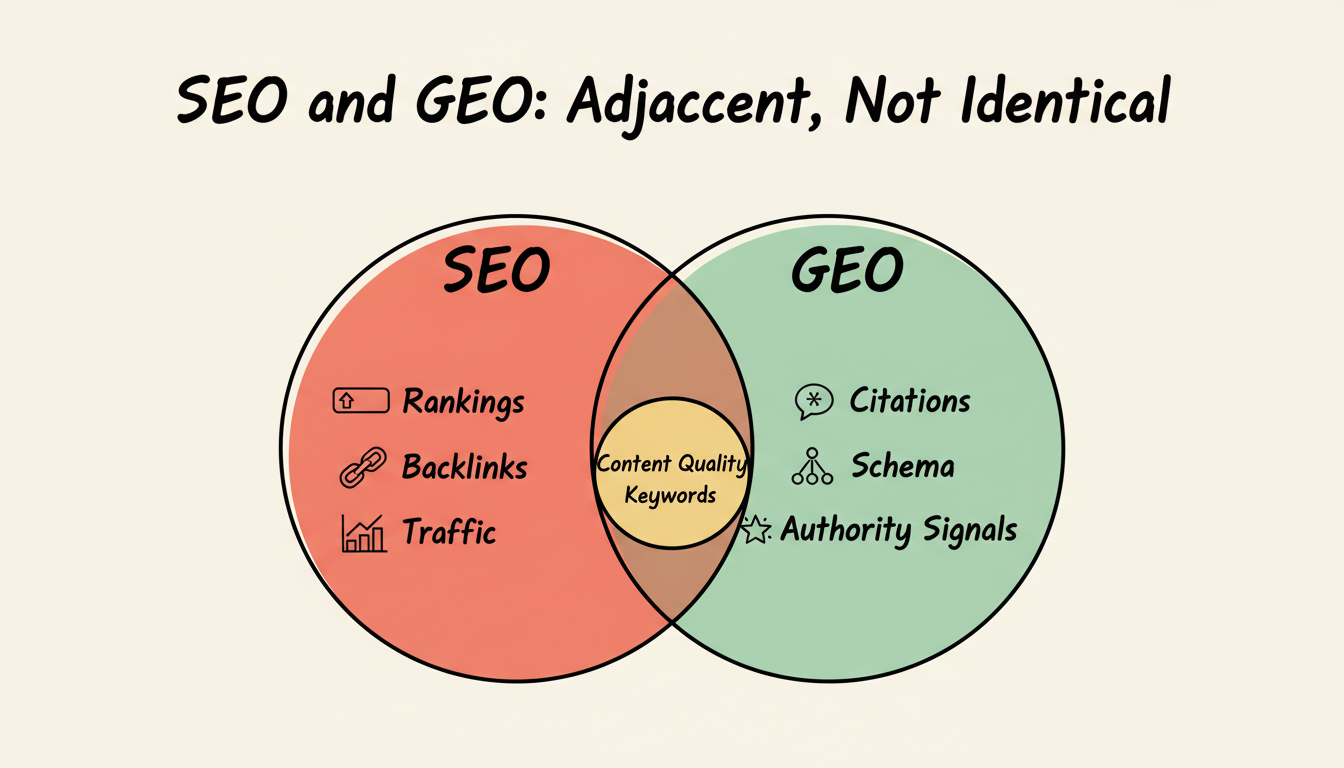
AI tools now generate answers instead of listing links. Your buyers read those answers and make decisions before visiting a single website. As a marketing leader, this changes how you allocate budget, measure performance, and build your team.
Generative engine optimization is the discipline of ensuring your brand appears in those AI-generated answers. Here is what you need to know.
What Most Marketing Leaders Get Wrong
Marketing leaders understand SEO. They have budgets for it. They have teams running it. The mistake is assuming that existing SEO investments automatically cover AI search.
They do not. Traditional SEO optimizes for ranking position. Generative engine optimization focuses on citation likelihood. A page can rank first on Google and never appear in a ChatGPT response or AI Overview.
Most marketing leaders also underestimate the speed of adoption. AI search tools are not niche products. ChatGPT has hundreds of millions of users. Google AI Overviews appear on a growing share of queries. Perplexity is gaining traction with business users. Your buyers are already using these tools.
The typical response is to assign the SEO team to “also handle AI search.” That fails because the skill sets overlap but are not identical. AI optimization requires content restructuring, schema implementation, and measurement frameworks that most SEO teams have not built.
Generative engine optimization is not a subset of SEO. It is an adjacent discipline that requires dedicated strategy, measurement, and execution. Treating it as an afterthought guarantees underperformance.
What to Look for in a Generative Engine Optimization Partner
Building this capability in-house takes time most marketing leaders do not have. Here is how to evaluate external partners.
Combined Strategy Across Paid, Organic, and AI
Generative engine optimization does not exist in isolation. Paid media data reveals which queries convert. Organic authority influences AI citation rates. The right partner integrates all three channels into one strategy with unified measurement.
Measurable CAC Impact
Marketing leaders report to boards and executives. “We increased AI citations” is not a boardroom metric. You need a partner who ties generative engine optimization directly to customer acquisition cost reduction and pipeline growth. Look for proven results, like documented CAC reductions of 30 percent or more.
Experience at Your Stage
A partner who has scaled hundreds of companies from Seed to IPO understands the difference between optimizing for a Series A startup and a publicly traded enterprise. Stage-appropriate strategy matters. The wrong advice at the wrong time wastes months and budget.
Execution Speed
AI search evolves weekly. Monthly reporting cycles are too slow. Your partner should deploy optimizations in days and measure impact in real time. This urgency is especially critical for venture-backed companies where time is the most expensive resource.
A team that specializes in answer engine optimization brings this combination of speed, measurement, and cross-channel integration to the engagement.
Building Your Generative Engine Optimization Roadmap
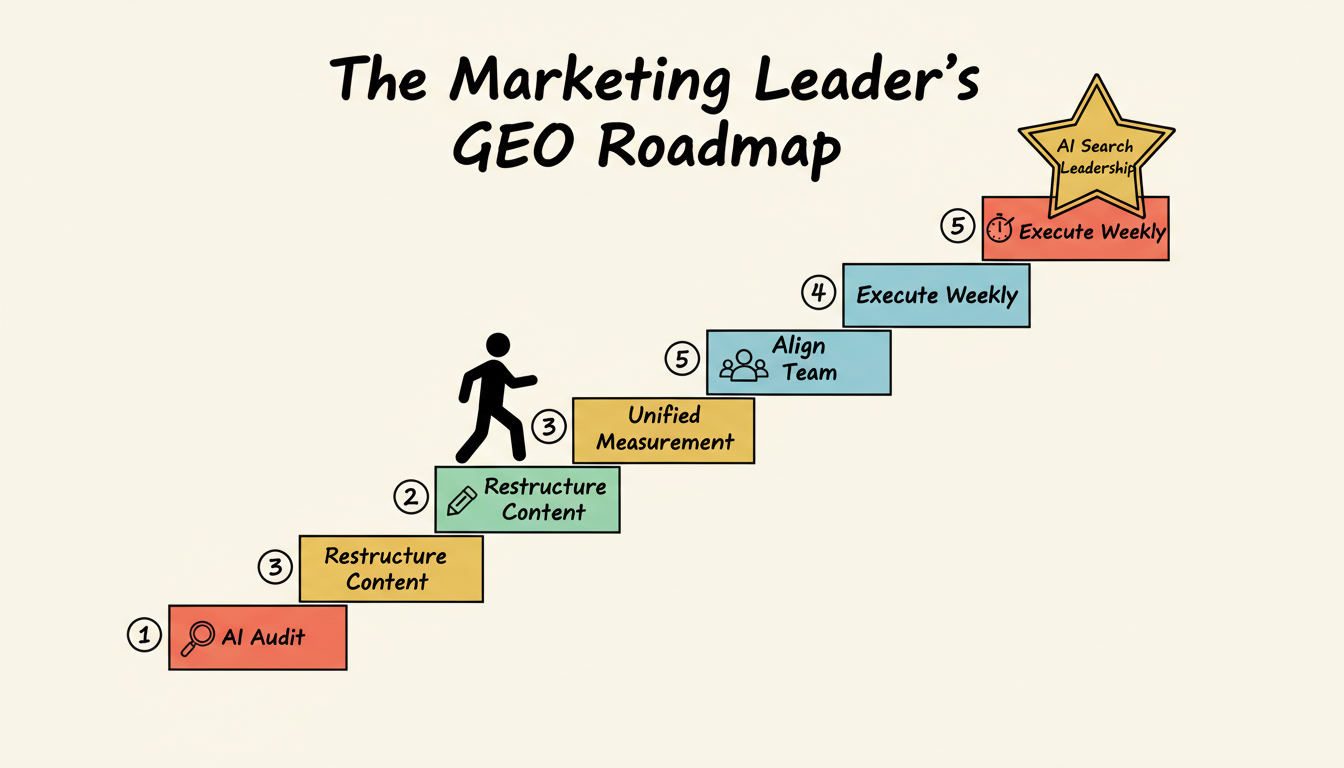
- Commission an AI visibility audit. Before allocating budget, understand your current position. Map your brand’s presence across ChatGPT, Perplexity, Google AI Overviews, and Copilot. Identify gaps relative to competitors.
- Restructure your highest-value content. Start with the pages that drive the most pipeline. Rewrite them for AI extraction: clear answers, structured headers, schema markup, concise paragraphs.
- Build a unified measurement framework. Create dashboards that track AI citations alongside traditional metrics. Connect both to pipeline and revenue. This gives you one view of how search, in all its forms, drives business outcomes.
- Align your team structure. Generative engine optimization requires collaboration between content, SEO, paid, and analytics. Break down silos. Create shared KPIs that incentivize cross-channel performance.
- Set quarterly review cadences with weekly execution. Strategy evolves quarterly. Execution happens weekly. An answer engine optimization partner should deliver both the strategic framework and the operational tempo your team needs.
The Leadership Decision
Generative engine optimization is not a tactical adjustment. It is a strategic bet on where buyer attention is moving. The marketing leaders who make this bet now will build an advantage that compounds over the next two to three years.
The leaders who wait will face a harder problem later. AI models build citation habits. Sources that appear consistently earn more trust and more citations. Breaking into that cycle after competitors have established themselves is significantly more expensive.
This is a decision that belongs at the leadership level. It affects budget allocation, team structure, and measurement frameworks. It requires executive sponsorship and cross-functional alignment.
The buyers in your market are already using AI tools to research solutions. The question is whether they find your brand in those results or your competitors’. That outcome is not determined by luck. It is determined by the decisions you make now.